System PositionPIR Preferred. PUR Where Appropriate.
Compare PIR and PUR together. BESRIN generally recommends PIR for balanced fire, thermal and long-term stability performance, while PUR remains an option where temperature, compliance and cost requirements are defined. Final performance depends on formulation, density, facings, profiles, joints, details and relevant test evidence.
THERMALHigh-Performance Insulation
Control thermal bridges and energy use through panels, joints and details together.
View Details WEATHERAirtightness & Weather Resistance
Define sealing paths for roofs, walls and low-temperature spaces.
View Details INSTALLATIONInstallation Efficiency
Profiles, lengths, lifting and coordinated details determine site efficiency.
View Details COMPLIANCEStandards Compatibility
Select products for the market’s regulations and test requirements.
View Details Why BESRIN Manufacturing?
Reliable products require consistent manufacture, accurate coordination and dependable delivery. BESRIN applies equipment capability, process control, inspection and project planning to every batch.
EQUIPMENTSpecialist Equipment
Equipment for forming, bonding, fabrication and dimensional control.
View Details PROCESSConsistent Processes
Combine key parameters with first-piece checks and in-process inspection to reduce variation.
View Details QUALITYQuality Control
Incoming, in-process and final inspections with batch and project identification.
View Details DELIVERYCoordinated Delivery
Panels and accessories numbered and packaged by project zone and installation sequence.
View Details Two Materials. A Clear Comparison.
Compare PIR and PUR core options here. Performance must be confirmed against the selected specification and its test reports.
PIR / RECOMMENDEDPIR: Preferred Option
Typically offers balanced fire behavior, temperature range and dimensional stability for industrial and cold-chain projects demanding long-term performance.
View Details PUR / OPTIONALPUR: Application-Specific Option
Efficient insulation and economy for conventional chilled and frozen storage with defined temperature and compliance requirements.
View Details THERMALThermal Performance
Both are efficient insulating cores. Assess thickness, joints, thermal bridges and aging alongside conductivity.
View Details SELECTIONSelection Guidance
Evaluate PIR first, then compare PUR lifecycle costs where budget, temperature and fire requirements permit.
View Details PIR Insulated Metal Roof Systems
For industrial, manufacturing and warehouse roofs. Confirm slope, drainage, wind loads, fixing, panel length, rooflights and openings together.
Image pending · PRODUCTPIR Insulated Roof PanelRoof panel and joint photography is being prepared.
Wall ProductPIR Insulated Metal Wall Systems
For industrial, warehouse and manufacturing facades. Coordinate facings, profiles, orientation, facade modules, opening trims and wall bases.
Image pending · PRODUCTPIR Insulated Wall PanelWall panel, joint and installed facade photography is being prepared.
PIR/PUR Technical Comparison | Parameter | PIR (Preferred) | PUR (Optional) |
|---|
| Core | Rigid polyisocyanurate foam | Rigid polyurethane foam |
| Core Density | 38–45 kg/m³ | 38–42 kg/m³ |
| Reaction to Fire | Class B1 (GB 8624) | Class B2 (GB 8624) |
| Thermal Conductivity λ | ≤0.022 W/(m·K) | ≤0.022 W/(m·K) |
| Panel Thickness | 40 / 50 / 60 / 75 / 80 / 100 / 120 / 150 mm | 40–150 mm |
| Metal Facings | 0.4–0.6 mm galvanized / Aluminum-zinc-coated steel | 0.4–0.6 mm galvanized / Aluminum-zinc-coated steel |
| Facing Coating | PE / HDP / PVDF / PVC film | PE / HDP |
| Thermal Transmittance K | 0.18–0.50 W/(m²·K), depending on thickness | 0.18–0.50 W/(m²·K), depending on thickness |
| Service Temperature Range | -50°C to +110°C | -30°C to +80°C |
| Dimensional Stability | Excellent (low shrinkage) | Standard |
| Profile / Joint | Four-sided tongue-and-groove / Concealed fixing / Interlocking joint | Four-sided tongue-and-groove / Concealed fixing |
| Roof Panel Width | 1,000 mm | 1,000 mm |
| Panel Length | ≤16,000 mm (roof) | ≤14,000 mm (roof) |
PIR/PUR High-Performance Envelope Applications
Select PIR or PUR for cold-chain applications here. PIR is preferred for demanding fire, thermal and stability requirements; PUR is available for clearly defined temperature, compliance and cost conditions.
Equipment & ProcessContinuous Production & Manufacturing Process
Facing treatment, roll forming, foam metering, double-belt curing, cutting and packing form a continuous process. Equipment and settings are confirmed for each specification.
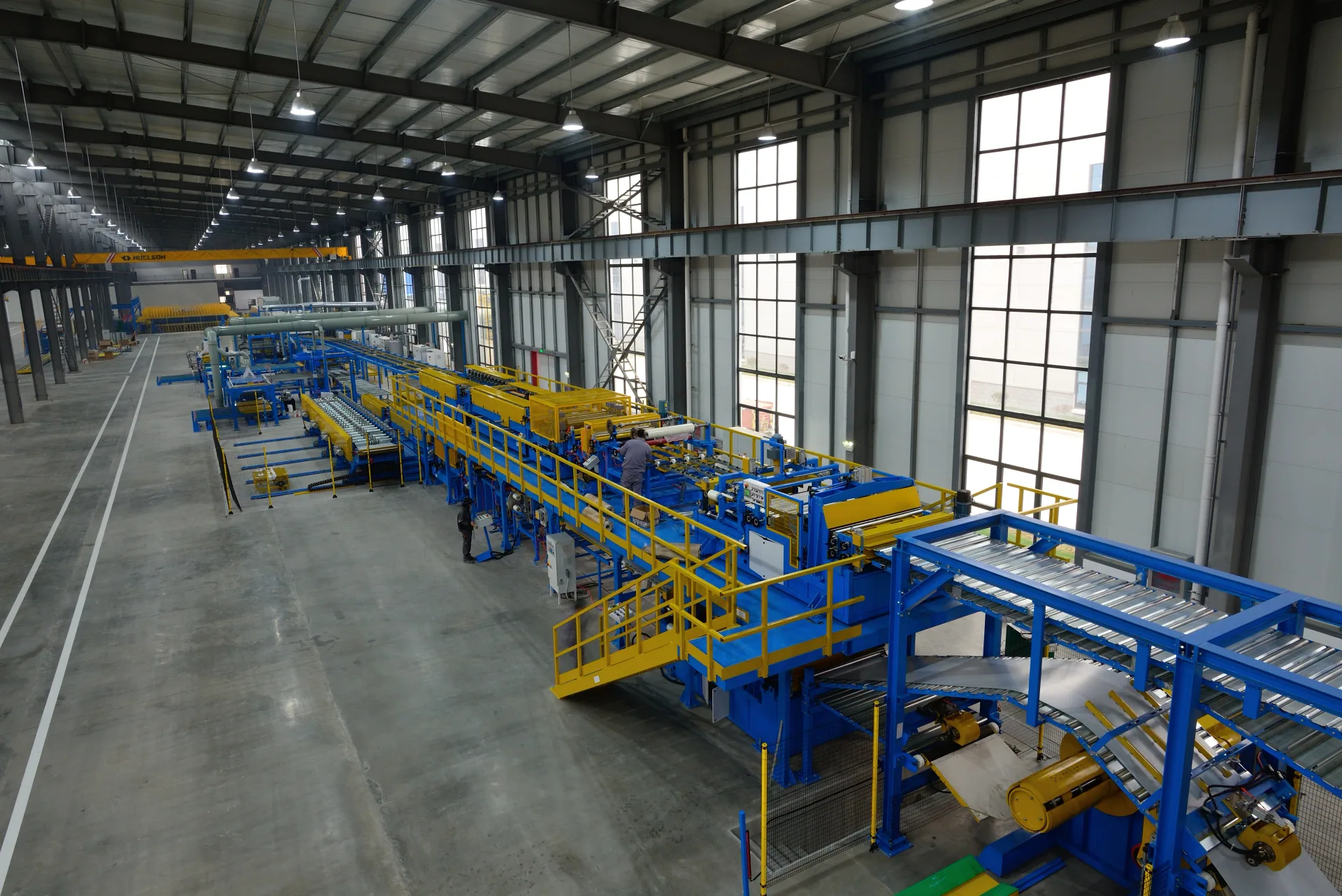
CONTINUOUS LINEContinuous Composite Production
Core density, closed-cell content, thermal uniformity and flatness depend on coordinated metering, double-belt temperatures, line speed and curing time. Siemens PLC monitoring and records support batch consistency.
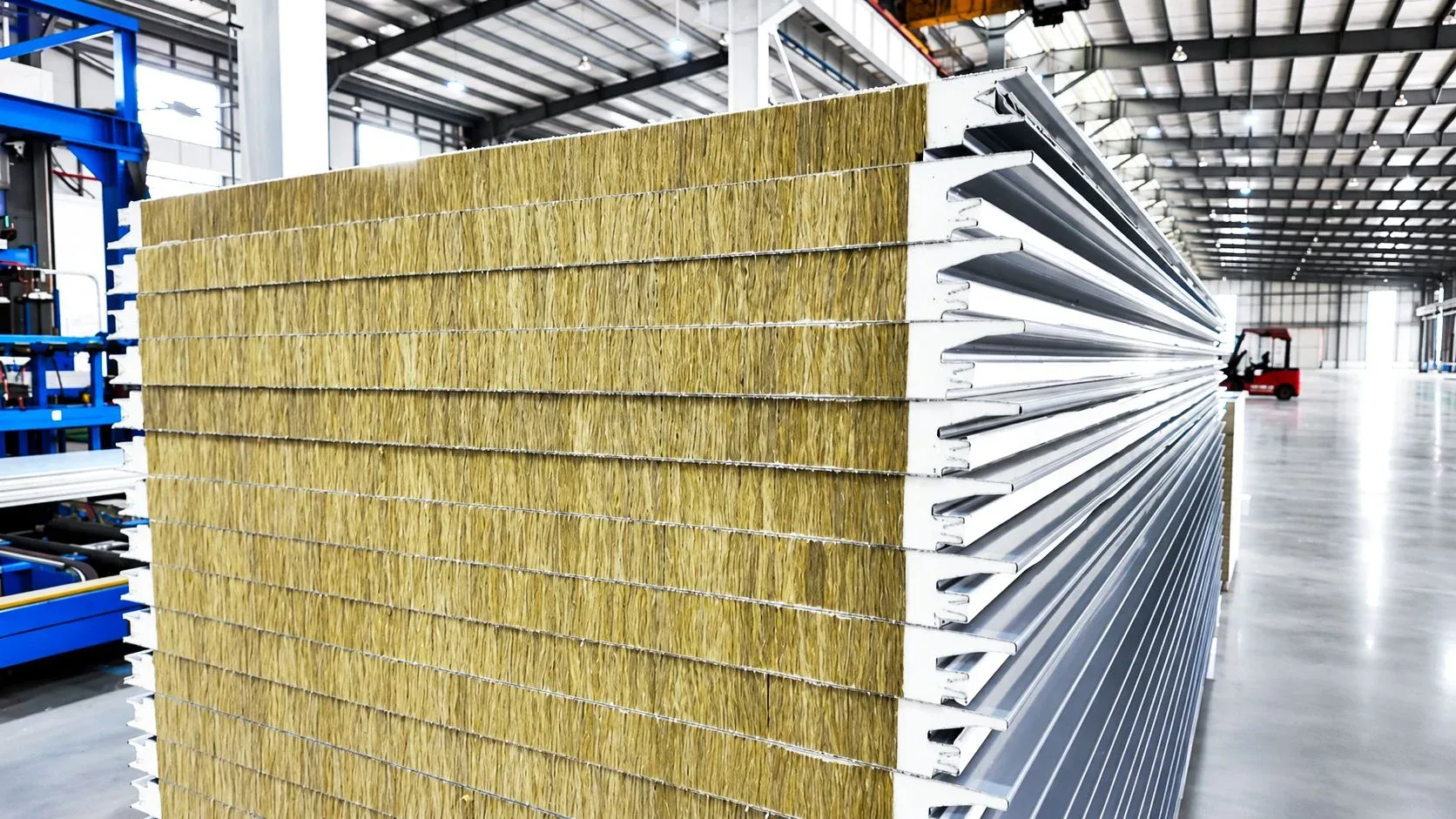
QUALITY CONTROLProcess Inspection & Final Verification
Check appearance, dimensions, joints, bonding and packaging identification.
01Facing Uncoiling
Continuous coil feeding and batch verification.
02Surface Treatment
Prepare a consistent bonding interface.
03Roll Forming
Form panel and joint geometry.
04Metering & Distribution
Meter and mix according to the product formulation.
05 / COREFoaming & Double-Belt Curing
Bond and cure under continuous pressure and controlled temperature.
06In-Line Cutting
Cut to suit project layouts and transport.
07Cooling & Inspection
Verify dimensions, surfaces and bonding.
08Stacking & Packaging
Identify by project, specification and batch.
SelectionConfirm Project Requirements Before Selection
Provide building use, market, roof or wall application, fire and thermal targets, temperature, humidity, corrosion exposure, structural layout and schedule before selecting core, thickness, facings, profiles and details.